Featured Post

Gearing Up for and Participating In ... The Hour of Code

Lately, we have hit the pause button on our library sleuthing skills and tuned into our tech problem-solving skills to participate in the Ho...

Showing posts with label storytime. Show all posts

Wednesday, November 25, 2015

Recommended Title: "Hug Machine" by Scott Campbell

The holidays can be a wonderful time to share books with your kids - but sometimes it can be hard to choose something that everyone will like. Speaking from personal experience, it's also often hard to find seasonally relevant picture books that are non-denominational AND well-written. For me, there's one go-to book that gets to the heart of what this time of year is all about without being too cloying, too sweet, or too specific.

Click on the picture to find this book in the Stevens Memorial Library catalog!
Hug Machine by Scott Campbell is a snapshot of the life of a young boy who's on a mission to spread joy and happiness though his hugs. He's excitable, relatable, and enthusiastic about his mission, proclaiming over and over, "I AM THE HUG MACHINE!" He hugs crying babies! Mailboxes! Spiky porcupines! Nothing he encounters is not worth an earnest squeeze.

I like this book for a few reasons. For starters, it's very silly, and uses a lot of active language to help the story feel action-packed. The illustrations are sufficiently detailed to offer new discoveries with every reading. It's also one of the only stories I've read about sharing kindness and affection that has a young boy as its protagonist. Our hero Hug Machine is definitely demonstrating the "E" in "RAISE" throughout this book!

This is Scott Campbell's first work as an author of children's books; previously, he illustrated Kelly DiPucchio's Zombie in Love and Zombie in Love 2+1. I'm a big fan of these books, so if you like his artwork you should definitely check them out - they are, however, decidedly more gruesome than Hug Machine.

Recommendation Snapshot:

Ideal Audience: K-4th grade (it's pretty short but would work as a discussion-starter for older grades).
Ideal Time of Day/Year for Sharing: holidays, Valentine's Day, bedtime
Worth Owning?: The art in this story will stand the test of time, I think, and the story makes for a great gift idea!
Parent Enjoyment Level: On a scale of 1-10, I'd put this at a solid 8 - it's cute without being saccharine, and will probably result in you getting lots of hugs! 

Wednesday, November 4, 2015

October Review!

Woah, we're flying through the school year, with October already behind us! We had a great month in the elementary libraries - we went on scavenger hunts, we read silly stories, and we firmed up what we know about the differences between Fiction and Nonfiction.


Kindergarten - Grade 2

With the youngest library detectives, we're starting the year off with practicing how to use the library and our books. In order to learn how to be responsible for our books, and take care of them properly, we first need to know the Parts of a Book.

First, we read Here Are My Hands by Bill Martin, Jr. and John Archambault.

Click on the picture to find this title in the Stevens Memorial Library catalog!
We got a chance to move our bodies a bit while reading this book - when we heard the word "hands" we waived our hands in the air! When we heard "feet" we stomped our feet!

Afterwards, we talked about the parts of our bodies and how books have parts to them too. We talked about how the covers help protect the insides of the book just like our skin protects us. We talked about how the book's title can tell you what kind of book it's going to be (a happy book! a scary book!) just like a person's face can tell you what kind of mood their in (grumpy! excited!). We talked about how both people and books have spines, and that spines help keep us standing straight and tall. Book spines also have the secret code so it's important that when we put library books back, the spines are always facing out! 

Next, we talked about the rules for the inside of the book, where we learned that you have to read the words on the page...no matter what! That's when we read The Book With No Pictures (click on the link for a recommendation!) by B.J. Novak.

Grades 3-5

In the older grades, we've been making sure we're experts in what constitutes fiction and nonfiction before we move on to how to use both kinds of books in our daily lives. It's challenging, not only because of the language ("non-fiction" sounds a lot like it should mean "not real"), but because it seems like our older grades have trouble distinguishing historical fiction (fiction that uses real facts to tell a made-up story) from non-fiction (real facts, nothing made up).

First, we reviewed what Fiction and Non-fiction mean - what are the parts of a fiction story? What about the parts of a non-fiction book? After a review - including reinforcing what we know about the SECRET CODES - we had our first Fiction & Non-fiction Challenge!
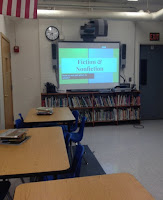

See those piles of books on the tables at Kittredge? They're part of the challenge!
Early in the morning, I covered up the spine labels (a.k.a. the Secret Codes) of a bunch of books, and placed piles in the middle of the tables at each library. After our review, students broke into five different groups, and each group had to make a pile of the books that were fiction, and the books that were non-fiction - all without using the secret code! They had to look inside the books (because you can't judge a book by its cover, after all!) to determine what kind of book they were. It gave us an opportunity to talk about historical fiction, biographies, and a few other genres that were a bit tricky! By the end, the kids were feeling more confident than ever about knowing the difference between fiction and non-fiction.

Next up: Kindergarteners start to learn about authors, younger grades learn all about book care and the "No No Never" Box, 3rd grade starts a discussion about online safety, and the older grades discover all the amazing resources our libraries have online!

See you later, Library Detectives!


Thursday, October 22, 2015

Recommended Title: "The Book with No Pictures" by B.J. Novak

I'm sure many parents are already familiar with this completely amazing book, but just in case you aren't aware - The Book with No Pictures by B.J. Novak is a delightful read-aloud that kids in North Andover are going crazy for! In fact, could it be the best read-aloud book EVER?!

Click on the picture to see this title in the Stevens Memorial Library catalog!
In our discussions about the Parts of a Book with the younger grades (more on this in a later post!), we talk about the "rules of a story" - i.e. that reading means "saying all the words on the page". The Book With No Pictures is all about this concept, and "tricks" grown-ups into reading silly words, sounds, and songs out loud!

Although many kids have read it before, a couple of classes were introduced to this title for the first time this week, and one kindergartner's reaction sums up the experience:

"I'm laughing so much I have tears coming out of my eyeballs!"

I'm working on getting at least one copy of this title for every elementary library; in the meantime, visit Stevens (or another local library) and pick up a copy today!

Recommendation Snapshot:

Ideal Audience: Preschool - 3rd grade.
Ideal Time of Day for Sharing: Anytime BUT bedtime! It's too silly!
Worth Owning?: Yes, but the novelty factor of reading it for the first time is part of the appeal.
Parent Enjoyment Level: On a scale from 1-10, this is easily an 11.

Wednesday, October 14, 2015

Scavenger Hunts; or, Navigating Our Library Space

The first few visits to the school library can be a little confusing, especially for little ones who may never have visited a library before. North Andover is lucky to have a wonderful library, the Stevens Memorial Library, that I'm sure many families have visited - but not every family. Therefore, the first time our students visit their school library, they might be feeling a lot of things:

  • Anxious ("Will I make a mistake?" "This doesn't look like my classroom.")
  • Overwhelmed ("Do I have to read all these books?!")
  • Stubborn ("I don't like reading, and I won't like the library.")
  • Excited ("We're out of class, this is just like recess!")
It's really important that we go over all the rules of using the school library at the start of the school year, just so every child is on the same page with regard to expectations. Once those rules are gone over (Lesson 1), we can move on to Lesson 2: Navigating Our Library Space.

Kindergarten - Grade 2

For the younger set, we have been reading "Alphabet Mystery" by Audrey Wood:

Click on the picture to see this title in the MVLC catalog!
We talk about what happens when the letters get jumbled up and out of order - it's no fun! 

Afterwards, we talk about how numbers are also in a special order, and to illustrate that, we sing Five Little Monkeys. 

BUT WAIT! It turns out that those little monkeys have scattered all over the library, and are hiding in the different sections! As a group, we quietly (so as not to startle the monkeys!) line up and march through the library space, pointing out the monkeys and the sections they're in. While most kindergarten/first grade teachers have expressed an interest in having students only check out picture books for the first few weeks, this exercise introduces the students to all the important places within the library. 

Grades 3-5

The older grades are (by and large) already familiar with the library space. However, what I've been noticing is that the older students know where the books are - "Diary of a Wimpy Kid is on this shelf!" - but not why the books are where they are. 

During our lesson, we go over the three basic call number labels, or "Secret Codes", for the books in the library:

E = "Everybody" or "Early Reader" - picture books & early readers
F/FIC = "Fiction" - chapter books
Numbers = Nonfiction 

I pose a challenge to the older grades to use what we've talked about, and what they already know about the books they're looking for, to find their books at check-out instead of using the catalog computers. This way, they can learn to recognize the important call number information so that when they do use the catalog, they know what all the call numbers mean and where they are.

Lastly, we break up into teams of two and do a quick Scavenger Hunt. The teams have to find a book representative of all the different sections in the library. One tricky one that's come up at the schools is Reference Books (i.e. books to "refer" to for a quick question, like a thesaurus, dictionary, or encyclopedia). We'll be getting better acquainted with these books as the year goes on, especially since in middle- and high-school students are expected to use reference books as research tools. 

That's all for now - stay tuned for more, Library Detectives!


Thursday, October 1, 2015

September Review!

What a fantastically productive month we've had in the elementary schools! Here's what we've done so far:


Kindergarten through Second Grade


1. We read D.W.'s Library Card by Marc Brown!

 Click on the picture for a link to the item in the Stevens Memorial Library Catalog!
Click the picture to find this book in the Stevens Memorial Library Catalog!
This is a great book that illustrates the way young kids learn to use libraries and library materials. D.W. learns how to get a library card, and how to take care of her library books. We use it in the library to talk about some anxieties younger kids might have about borrowing books - 
especially older books.  

2. We talked about what we already know about libraries!

I find sometimes younger children have expectations of the library experience that aren't necessarily in line with what actually happens in the library, so it's good to make sure we're all on the same page as we start out in the library together. For example, we talk about how some libraries have rules about how quiet you have to be, but that because our library is also a classroom, the same classroom rules apply: raise your hand, talk in a normal "inside" voice.

3. We learned "The Secret Code" for Picture Books

Part of the library program curriculum this year is talking about how to find books in the library. We introduce the concept of "the secret code of libraries" this week, and kids learn that Picture books are for EVERYBODY, so their secret code is the letter E!

4. We learned "The Watermelon Song"

This is my absolute favorite song to sing with younger children. I'll be including a YouTube video of it soon so you can sing it at home!

Third through Fifth Grade


1. We busted some "Library Myths"!

With the older grades, who may have had negative experiences in different libraries in the past, I think it's important to start out with a re-invigorated sense of excitement for libraries. We talk about some "myth-conceptions" that people have about libraries, and talk about whether they're true or false:
Myth #1: Librarians are old and mean and will yell at you. FALSE!
Myth #2: If you damage a book, you're banned forever. FALSE!
Myth #3: You must be super-duper quiet when you're in our library. FALSE!
*we talk a bit about how other libraries do follow that rule, but because we're a classroom as well,
we want to feel comfortable using normal inside voices. 
Myth #4: The library is JUST for books. FALSE!
Myth #5: All librarians love cats. TRUE!

2. We read The Librarian from the Black Lagoon by Mike Thaler

Click the picture to find this book in the Stevens Memorial Library catalog!
We use this book to start a discussion about the differences between fiction and nonfiction: how do you know this is fiction? What information is on the cover? The spine?

3. We took a look at That's Our Librarian by Ann Morris

Click the picture to find this book in the MVLC catalog!
Usually at this point in the lesson we just don't have time to read another book, so we look at That's Our Librarian and talk about the differences between this book (a nonfiction title) and the one we've just read: how can we tell this is fiction? What's the Dewey number for this title?

4. Exit Tickets

One way for me to gauge whether or not the students have absorbed the material we've been discussing is by passing out "exit tickets" at the end of the lesson. They are usually either multiple choice or open-ended questions, they are completely anonymous, and they aren't graded. I collect them, and analyze how many students were able to answer the question correctly - if too many kids don't quite understand the concept, I'll know to refresh and re-teach the next time they're in the library. So far, the average comprehension rate is a wonderful 93%!

See you in October, Library Detectives!